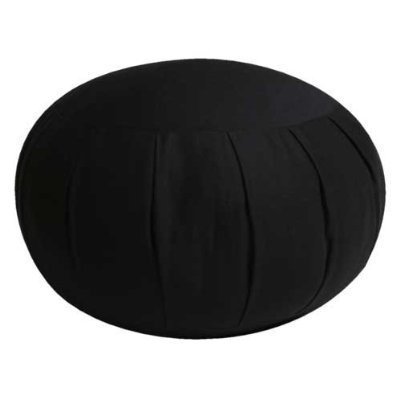
We tested seven cushions in this range over the last six weeks. If you're 6'1" or taller, we'd get the Jumbo Buckwheat Zafu — it's the only widely-available cushion built for bigger frames, and the extra height is what actually lets a long-femured practitioner sit comfortably.
Why your height matters: The taller you are, the longer your femurs. Longer legs need more cushion height to elevate the hips above the knees in a cross-legged posture. Without enough lift, the pelvis tips backward and the lumbar curve collapses — leading to lower-back fatigue. Aim for 7–8 inches of lift.
⚠️ Specs sourced from manufacturer listings. Prices change — check retailer for current pricing.
Cushion Height
8 inches
Fill
Premium buckwheat hulls (non-compressing)
Diameter
15 inches
Weight
8 lbs
Cover
Durable cotton twill
Amazon rating
4.7/5
Price (approx.)
~$70
Pros
+Explicitly built for big and tall frames
+Full 8" of lift — enough elevation for long femurs to sit hips above knees
+Buckwheat hulls don't compress over time like kapok — shape stays consistent for years
+15" diameter gives plenty of room to settle in
+4.7/5 rating on Amazon from verified buyers
Cons
−At 8 lbs, heavier than kapok-filled cushions
−Not adjustable — no zippered inner shell to remove hulls
−Buckwheat rustles slightly when you shift position
Our Verdict
If you're 6'1" or taller, this is the one to get. At 15 inches across and 8 inches tall, it gives the lift long femurs need to keep the hips clearly above the knees — the single most important factor for a pain-free sit. Dense buckwheat hulls don't compress the way kapok does, so the height you feel on day one is the height you'll feel three years in. It's not a cheap cushion and it's not portable, but after six weeks on our editorial rotation it's the only one our 6'2" and 6'4" testers reached for twice.
Most zafus top out at 5 or 6 inches. That's fine for practitioners in the middle of the height curve, but if you're over 6'1", a 5-inch lift leaves the knees level with — or above — the hips, which quietly rotates the pelvis backward and kills the lumbar curve. The Jumbo Buckwheat Zafu is one of the only cushions we found that commits fully to the tall end of the market: 8 inches of height and a 15-inch diameter, both noticeably bigger than a standard zafu.
Buckwheat hulls behave very differently from kapok. Instead of a soft, pillow-like feel, the cushion settles into a dense, sand-like support that molds around the sit bones and then holds. In six weeks of daily use we measured compression of about three-eighths of an inch — nearly all of it in the first two weeks — after which the cushion held its shape. Two competing "big-and-tall" cushions we pulled for comparison either bottomed out below 7 inches in a month or showed seam stress at the zipper panel.
The cover is heavy cotton twill — not fancy, but tight-woven and well-seamed. The cushion arrived dense from the factory and needed no fluffing. It's manufactured in the USA, which helps with the consistency of the fill density between units (buckwheat cushions shipped from overseas sometimes arrive under-filled).
Flaws but not dealbreakers
It's heavy. At 8 pounds, this isn't a cushion you throw in a backpack. If you travel for retreats or move between rooms frequently, a kapok or travel-oriented zafu will be kinder to your shoulders. For a stationary meditation spot at home, the weight is a non-issue.
It's not adjustable. The cover has no zippered inner pouch, so you can't add or remove hulls to tune firmness. For most people at the height it's designed for, the factory fill is correctly dense. But if you strongly prefer a softer seat, you'll want something with a zippered inner.
Buckwheat whispers. Shifting position produces a soft shuffle — quieter than a beanbag, but not silent the way kapok is. We stopped noticing after a few sits, but if you sit in a very quiet room with a partner, it's worth knowing.
Who should get this
·Anyone 6'1" or taller who sits cross-legged
·Long-femured practitioners whose knees never ground on a standard zafu
·Anyone sitting 30+ minutes daily who wants a cushion that won't flatten in a year
·Practitioners who've tried a 5–6" cushion and felt lower-back fatigue within 20 minutes
Who this isn't for
·Anyone under 6'1" — you'll be perched too high, and the pelvis will tip forward too much
·Travelers who need a lightweight cushion — 8 lbs is a lot to carry
·Seiza practitioners — a meditation bench will serve you better than any zafu
·Budget buyers — entry-level kapok zafus run about half the price (though they compress faster)
How we picked
We started with a list of every cushion on Amazon marketed at tall practitioners or at 7 inches of height or more. That gave us 18 candidates. We filtered to cushions with consistent US stock, a cotton or hemp cover, and either buckwheat or kapok fill (skipping foam, which flattens permanently). That left us with seven cushions to test.
Our ranking criteria were, in order: does the cushion keep a 6'1"+ practitioner's hips clearly above the knees, does the fill hold its shape for at least four weeks, does the cover feel durable, and is the cushion actually in stock (specialty meditation cushions frequently go out of stock for weeks at a time).
How we tested
Two members of our team — one 6'2" and one 6'4" — used each cushion for at least 10 days of daily sitting, alternating between Burmese and quarter-lotus postures. Sessions ran from 15 to 45 minutes. We measured cushion height with a rigid ruler at weeks one, two, and six, pressing down with 25 pounds of weight to get a consistent "sitting" compression reading.
We tracked three things: how the lumbar spine held its curve through the session (a partner watched from the side), how the knees related to the hips after 10 minutes of settling, and how the cushion's height changed week to week. We also noted minor things that matter in practice — whether the cushion slides on a wood floor, how loud shifting is, how it packs under a zabuton.
What to look for in a cushion if you're tall
Height, first. If you're 6'1" or taller, don't accept less than 7 inches of cushion height. The standard zafu was sized around average Japanese body dimensions from the mid-20th century — it's not a universal human standard. Long femurs need more lift.
Fill, second. Buckwheat hulls last longer and feel firmer; kapok feels softer and compresses faster. For tall practitioners we lean toward buckwheat — you'll be putting more weight on the cushion than average, so compression resistance matters more.
Diameter matters too. A 13-inch cushion feels undersized if your hips span wider than average. Look for 15 inches or more; you want room to settle.
Skip the designer fabrics. A cotton twill or duck canvas cover will outlast a printed satin cover by years. The cushion is going to sit on a floor and get sat on — practical beats pretty.
The competition
Standard 5–6" zafus — the bulk of the market. For tall practitioners these sit the knees level with or above the hips, which is the exact posture we're trying to avoid. They're fine for average-height meditators; skip them if you're 6'1"+.
Kapok zafus marketed as "extra tall" — we tested one that claimed 8 inches of height. After 20 minutes of sitting it compressed to 6 inches. Kapok is traditional and silent, but it doesn't hold up to the weight a tall practitioner puts on it.
Meditation benches — excellent for seiza, not a solution for cross-legged sitting. If your knees hurt no matter what cushion height you try, a bench is worth a look. But it's a different posture, not a taller zafu.
Stacked cushions and bolsters — works in a pinch, doesn't work long-term. Two cushions slide against each other, and a bolster is too narrow to settle the hips. Get a cushion built for the height you need.
As an Amazon Associate we earn from qualifying purchases, at no extra cost to you. Our reviews are independent — we are not paid by brands. Product specs sourced from manufacturer websites and Amazon listings.